Tango Classes in Derby
Tango Derby
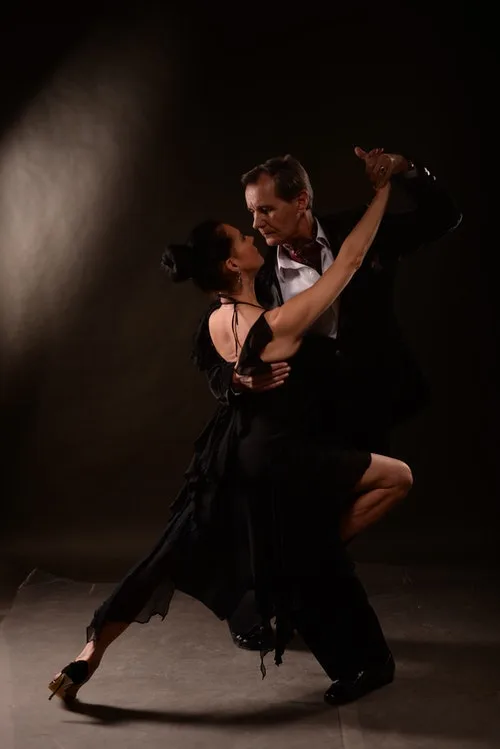 Tango — Derby
Class is coming soon
Fill out the form for more info
Class Details
Location: TBC
Day: TBC
Time: TBC
Age Group: 17 – 75
Teacher: —
Class Structure
Beginners Class — 60 Minutes
Posture and the Plain Walk
The odd truth about tango is that lesson one holds no steps — you spend the first stretch simply learning to stand well and to move smoothly across a room. It feels almost too basic, yet a confident, level walk is the spine of the whole dance, and getting it honest now saves you months of trouble later.
Settling Into the Frame
Next you and a partner form the hold tango calls the embrace. It sounds far more romantic than it plays: really it is a stable point of contact, the wire along which one dancer's intention reaches the other. Comfortable and unfussy, it is where all the quiet listening actually happens.
The Turning Shapes
Only now do the shapes you might picture turn up — the figure-eight ochos, the pivots, the long lazy sweeps. We learn them at half speed on purpose. Tango cares nothing for how many moves you can reel off; it asks only whether the one you pick is clean, weighted and properly finished.
Building It Live
Here is tango's real trick and its whole appeal: there is no fixed routine to recite. Through small guided exchanges you and your partner put a short dance together as you go, deciding move by move. The relief arrives fast — nothing learned to forget, just a running back-and-forth to sustain.
A Short Social to Close
The hour ends on a pair of genuine tango songs danced socially — no counting, no corrections, just you having a proper go for keeps. Treat it as a miniature milonga, the informal gatherings the whole craft exists to fill, and usually the moment a beginner first feels the pull of it.
About Tango Classes in Derby
Set aside the cliché of a rose gripped between the teeth — that is stage spectacle, and Argentine tango is a much quieter, more inward affair. Strip it down and only two things really count: a comfortable embrace and a walk that a couple make up together as the music unfolds. Nothing is choreographed ahead of time, which is oddly why beginners relax into it once they stop performing.
There is no need to bring anyone. The class rotates you through everybody, and you take on leading, following, or a bit of each by feel rather than by memorising counts — which is exactly why arriving alone works so well. Because you carry only a small toolkit of movements and improvise the rest, there is nothing to blank on, and people happily stay with tango for years.
Our partner studios sit in the middle of Derby, close to the Cathedral Quarter, and it is a good fit — the narrow Georgian streets around Iron Gate and Sadler Gate move at exactly the ambling pace the dance asks of you. The Morledge bus station is the handier arrival than the railway station over on the east side, and the precise venue reaches you once your place is booked.
Browse all 20 of our dance classes in Derby, or see tango classes in our other 66 cities.
Fill Out the Form for More Info
Fill in your details for up-to-date class info.
Why Choose Tango in Derby?
The Walk Is the Foundation
Everything advanced in tango stands on the plain ability to walk well beside a partner, which is reassuring when you are new — you are not hunting a pile of tricks, only one very human skill done with attention. Master the walk and the frame and you are genuinely dancing; all the rest is refinement gathered across years.
No Partner Needed
Bring nobody and you lose nothing. Dancers change places right through the session and we cover leader and follower both, so a solo arrival ends the hour having partnered the whole room. That endless changing of hands is what hones the fine sensitivity the dance runs on.
Nothing to Learn by Heart
With every dance improvised, no long sequence hangs over your head and no cue can be forgotten mid-song. You keep a compact kit of movements and hold a conversation with it in real time — the reason people still find tango fascinating a decade in rather than exhausted within a term.
Made for These Streets
Taking tango up around the Cathedral Quarter has its own rightness: the unrushed, walkable Georgian lanes you might wander before dinner echo the very pace the dance keeps. It is a fitting pocket of Derby in which to fall for a partner dance built on patience.
Your Tango Journey
From first class to confident dancer — here is how it usually goes.
Walking and Holding
The Very First Weeks
Almost all of the early going is posture, the walk and growing at ease inside the embrace. That is deliberate — tango would far rather you did one small thing beautifully than several things scrappily — and these plain roots are what let the ornate material flow later on.
What to Wear
Smart-casual clothes with room to move, and shoes whose sole slides rather than sticks — leather is spot on, though any non-grippy pair serves at the start. Wear heels or skip them entirely; a clean, balanced pivot matters far more than any amount of height.
Shapes Arrive
A Growing Vocabulary
The walk now picks up companions — ochos, pivots, gentle turns — and the embrace changes from something awkward into something that actually tells you things. You begin sensing a partner's direction through the frame instead of watching their feet, and that is the moment it all clicks into place.
Choosing a Role
Leading and following both open up, and you get to pick. One teaches you to trust, the other to be clear. Trying a little of each is common, and it quietly improves whichever role you finally settle into.
Off the Page
Improvising Properly
Now you compose little dances live from what you know, inventing them to whatever the music happens to do. It unsettles you for a track and then frees you completely — no recall required, only choices made on the spot, and that liberty is precisely what hooks people on tango.
Answering the Music
You start hearing the shape of a tango — the held breaths, the swells — and replying to it, going still when it stills and pushing when it drives. This is the point where steps become expression and the dance turns into something you are genuinely saying.
Onto the Social Floor
Holding Your Own
You can now cope in a social tanda, adjust from one partner to the next and drop into the deep, quiet focus a good dance brings. Those early nerves have gone, replaced by the composed attention tango is so admired for.
The Long Game
After this it might mean milongas near and far, a serious study of musicality and technique, or simply a lifetime inside the richest partner dance there is. Tango is meant to be a road without an end, which is why almost nobody who takes it up ever leaves.
Tango in Derby FAQ
Everything you need to know before your first class.
People picture a rose and a dramatic head-snap — is that really tango? +
That is the ballroom-and-film version, and it could hardly be less like the real thing. Argentine tango is close, calm and made up as you go, danced for the two of you rather than a crowd — no props, no theatrics, just walking and turning to some gorgeous music.
Can I come along without a partner? +
Absolutely. You rotate through everyone in the room and we teach both roles, so booking on your own is completely usual — arguably better, since partnering lots of people teaches you to feel and adapt far quicker than sticking with one face all night.
How is this different from the tango they do on Strictly? +
Night and day. Competition ballroom tango is locked choreography, held rigid and upright for the judges. What we teach is Argentine tango — improvised, soft in the hold, different every single time, and social rather than staged. Most people warm to the Argentine sort the instant they try it.
Do I need to be fit or a born dancer? +
Neither. You walk tango, you don't sprint it, and it prizes balance and connection over athletic power or flexibility — which is why it suits every age and build. We assume outright beginners; a patient, curious head gets you further here than raw talent ever does.
Whereabouts in Derby is the class held? +
At partner studios in the centre near the Cathedral Quarter, whose Georgian lanes happen to suit the dance's walking pace. You'll be told the room on booking. The Morledge bus station is close and more central than the railway station, which sits over to the east of the city.
How much does a class cost? +
It's £8 to drop in, with nothing to join and no contract, so trying tango costs you a single session's fee. Once your studio's weekly slot is fixed, cheaper multi-week blocks open up for anyone who decides to keep going.
Can I try both the leading and the following? +
Yes, and we'd rather you did. Both are taught from the outset, so commit to one or move freely between them. A follower who grasps leading reads the signals better, and a leader who has followed leads more kindly — so a taste of each helps every part of your dancing.
What should I put on my feet? +
Comfortable clothes you can move in, and footwear with a smooth, non-sticky sole so it turns cleanly — leather-soled shoes are ideal but not essential to begin. Heels are entirely up to you; steadiness and a clean pivot count for far more than height.
Is there anywhere to actually dance tango in Derby afterwards? +
The weekly class is the steady part; the social side locally is modest — an occasional milonga around the region rather than something nightly, and we'd sooner say so than dress it up. Once your walk and embrace are dependable, the teachers can point you to the nearest floors worth a first outing.