Tango Classes in Southampton
Tango Southampton
 Tango — Southampton
Class is coming soon
Fill out the form for more info
Class Details
Location: TBC
Day: TBC
Time: TBC
Age Group: 17 – 75
Teacher: —
Class Structure
Beginners Class — 60 Minutes
Standing and Walking
Oddly, the first lesson holds no steps. You spend the opening minutes learning to stand well and to travel smoothly across the floor. It feels almost too plain, but a calm, level walk is the backbone of the whole dance, and getting it honest now saves months later.
The Embrace
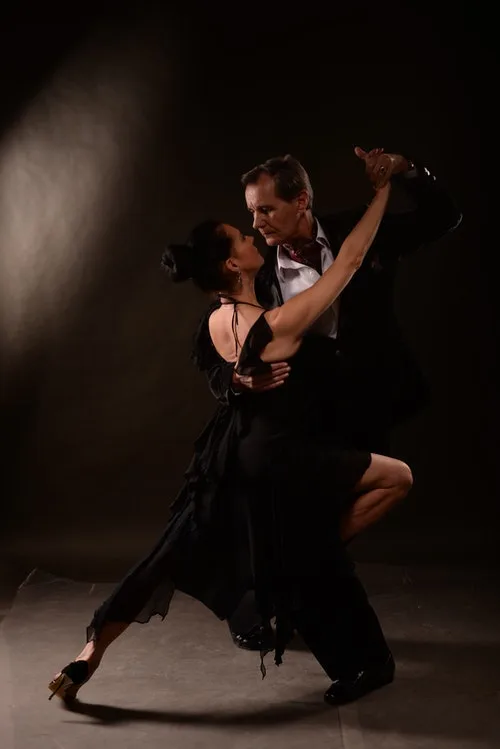
Next you and a partner build the hold tango calls the embrace. It is less romantic than it sounds — really it is a steady point of contact, the line along which one dancer's intention travels to the other. Comfortable and unshowy, it is where the quiet listening happens.
The Shapes
Now the figures you might picture appear — the ocho's figure-eights, the pivots, the long slow sweeps. We take them at half speed on purpose. Tango does not care how many moves you can list; it asks only whether the one you choose is clean and properly finished.
Made Up Live
Here is tango's real trick: there is no set routine to recite. Through small guided exchanges you and your partner assemble a short dance as you go, choosing move by move. The relief comes quickly — nothing memorised to forget, just a running conversation to keep going.
A Short Milonga
The hour closes on two genuine tango songs, danced for real — nobody counting, nobody correcting, just you having a go. Treat it as a miniature milonga, the low-key social nights this whole dance is built to fill, and usually where a beginner first feels the pull.
About Tango Classes in Southampton
Most people picture tango as something fierce and theatrical — a snapped head, a rose, a stamp. Real Argentine tango is almost the opposite: unhurried, close and quiet, more like a slow conversation than a performance. Two people share an embrace and walk together, and the whole art lives in how well they listen to each other. Beginners are often surprised by how calm it feels.
Nothing is choreographed. Rather than memorise a routine, you gather a handful of movements and then improvise them in the moment, deciding with your partner where to go next as the song plays. That is why turning up without a partner is genuinely fine — the class rotates everyone, you try both leading and following, and there is no sequence to rehearse in a pair beforehand.
Learning it in Southampton has a nice logic. Tango was born among the dockside barrios of Buenos Aires, and Southampton is Britain's own great ocean port; the slow, walkable streets of the medieval Old Town, down toward the waterfront and Oxford Street, move at the very pace the dance wants. Your studio sits centrally near the Cultural Quarter, a short walk or bus from Southampton Central, and you get the address on booking.
Browse all 20 of our dance classes in Southampton, or see tango classes in our other 66 cities.
Fill Out the Form for More Info
Fill in your details for up-to-date class info.
Why Choose Tango in Southampton?
Built on a Simple Walk
Strip tango down and the core skill is walking beautifully with someone. That is oddly comforting for a beginner: no long trick-list to conquer, just one grounded, human thing to get right. Nail the walk and the embrace and you are already dancing — everything after that is detail.
Solo Is Welcome
Book alone with no worries. Since partners change all evening and we teach leader and follower alike, a single arrival still dances the whole room. All that changing around is what sharpens your feel for another person, which is the heart of the dance.
A Dance, Not a Script
Nothing is set, so there is no routine to memorise and nothing to forget under pressure. You hold a small set of moves and improvise the rest, like a chat rather than a recital — which is why it stays interesting for years rather than months.
A Port Dance in a Port City
Tango came up in a harbour town, and Southampton has been one since the Middle Ages. There is something fitting about learning a patient, listening dance among the old walls and quiet lanes of a city shaped by the sea.
Your Tango Journey
From first class to confident dancer — here is how it usually goes.
The Groundwork
Just Walking
The opening weeks are almost entirely posture and the walk, plus getting used to standing close in the embrace. It feels modest, but this is the whole foundation — do it patiently now and the fancier material has something solid to sit on later.
On Your Feet
Wear something smart-casual you can move in, and shoes that glide rather than grip — a leather sole is perfect, but any non-sticky pair is fine early on. Heels optional entirely; a steady, balanced turn beats height every time.
The Vocabulary Grows
New Shapes
Ochos, pivots and small turns join the walk, and the embrace starts to feel like a channel of information rather than an awkward hug. You begin reading where your partner is going through contact instead of staring at their shoes.
Lead or Follow
Both roles are on the table and you choose. Leading teaches clarity, following teaches trust, and dabbling in each makes you better at whichever you keep. Nobody is pushed one way by gender here.
Speaking Freely
Making It Up
You start building short dances live, choosing steps to suit the music as it happens. It rattles you for a track, then suddenly liberates you — no memory to fail, only decisions in the moment, and that freedom is what keeps people coming back.
Hearing the Song
You tune into a tango's rises and pauses and answer them — stilling when it stills, driving when it lifts. This is where the footwork turns into something expressive, and the dance starts to feel like it is saying something.
On the Floor
Comfortable Anywhere
You can hold your own through a whole tanda, adapt to each new partner and sink into the quiet concentration a good tango brings. The early jitters are long gone, swapped for calm attention.
No Finish Line
From here it is milongas wherever you can find them, deeper study of music and technique, or simply years of enjoyment — tango rewards a lifetime and rarely lets go of anyone who gets properly into it.
Tango in Southampton FAQ
Everything you need to know before your first class.
Can I come on my own, with no partner? +
Yes, and plenty do. Everyone rotates through the room and we teach both roles, so a solo booking is completely normal — you might even progress faster, since reading lots of different partners trains your sensitivity quicker than pairing off with one.
The films make tango look intense — is it really like that? +
That intense, rose-in-teeth version is stage and screen. Argentine tango is soft, close and improvised, danced for the couple rather than an audience. No drama, no props — just a calm walk and turns set to some beautiful old music. Most beginners are relieved by how gentle it feels.
Is this the same as Strictly's tango? +
Not at all. The ballroom tango on television is fixed choreography, held sharp and upright for the judges. Ours is Argentine — improvised, relaxed in the hold and different every dance. They share a name and little else, and most people take to the Argentine kind straight away.
Do I need to be fit or a natural mover? +
No. Tango is walked, not sprinted, and rewards balance and connection over strength or flexibility, so it suits every age and shape. We start from the very beginning; patience and curiosity carry you much further here than natural talent.
Where in Southampton do lessons happen? +
At partner studios in the centre near the Cultural Quarter and the Old Town, whose slow lanes suit the dance nicely. The room is confirmed on booking, and it is a short walk or bus ride from Southampton Central.
What will a class set me back? +
£8 per drop-in, nothing to join and no contract, so a first taste of tango costs one session. When your studio's weekly slot settles, multi-week blocks open at a lower rate for anyone continuing.
Can I learn to lead and to follow? +
Yes — we would encourage it. Both are taught from day one, so specialise or swap freely. A follower who understands leading anticipates better, and a leader who has followed guides more gently, so a taste of each lifts your whole dancing.
What footwear works best? +
Comfortable clothes with room to move, and a smooth-soled shoe that turns without catching — leather soles are ideal, though any non-grippy pair does to begin. Heels are your call; a clean, steady pivot matters far more than the height of your shoe.
Is there anywhere in Southampton to dance tango afterwards? +
The class is the reliable weekly fixture; socially, the local milonga scene is quiet — the odd regional night rather than something weekly, and we would rather be honest than oversell it. Once your walk and embrace are solid, your teacher can steer you to the nearest floors worth trying.