Tango Classes in Wolverhampton
Tango Wolverhampton
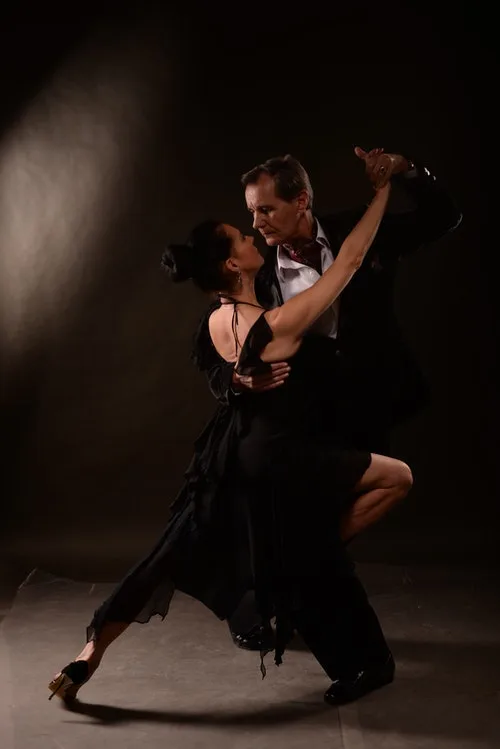 Tango — Wolverhampton
Class is coming soon
Fill out the form for more info
Class Details
Location: TBC
Day: TBC
Time: TBC
Age Group: 17 – 75
Teacher: —
Class Structure
Beginners Class — 60 Minutes
Standing and Stepping
We open on your own two feet: balancing your weight over one leg, then shifting to the other without a wobble. No partner yet and no figures — just the unglamorous business of owning your own balance, which every later move quietly leans on.
Meeting in the Embrace
You pair up and find the embrace, tango's close connection. We treat it as posture and pressure rather than romance — chest tipped a little toward each other, a calm shared frame. Most of the lesson's real information travels silently through this contact, so comfort here comes first.
Walking as a Pair
Now the two of you travel together, the leader proposing a direction and the follower going with it. Long before any ochos, a couple who can simply cross the floor in time already reads as tango. We add a pivot or a turn only once the shared walk holds up.
Choosing on the Spot
Here is the surprise: nothing is set beforehand. With a few gentle prompts you begin deciding, breath by breath, which step lands next. There is no sequence stored away to recall, and therefore none to lose — only a running exchange you keep answering through your feet.
A Taste of the Milonga
We finish with a track or two danced for real, no counting aloud and no corrections. Picture it as a pocket-sized milonga, the easygoing social night tango is truly written for, and usually the point where a newcomer grasps why people give this dance decades.
About Tango Classes in Wolverhampton
People arrive braced for theatre — flung heads, a clenched rose, staccato stamps. The real Argentine article runs the other way entirely: unhurried, softly held, closer to two friends talking as they stroll than to any spotlit routine. The whole discipline is attention — sensing, through a light frame, precisely what your partner is about to do. Newcomers tend to be startled by how settling an hour of it feels.
Because a tango is assembled as it happens rather than memorised, there is no routine hiding inside it to trip over. You gather a modest kit of movements and recombine them live, agreeing each choice with your partner as the music moves. That is also why booking alone works perfectly well — everyone rotates, you sample both roles, and nobody expects you to have rehearsed anything with a regular beforehand.
On Wolverhampton itself we will not oversell. The city has a genuine appetite for social dancing, yet a milonga you could pencil in every single week is not part of the fixed calendar — which is precisely the gap this class fills, as your one dependable tango evening. Once your walk and embrace can carry you, the teacher will send you toward the practicas and milongas dotted across the wider West Midlands. The room is central, minutes on foot or by Metro from the railway station, address following your booking.
Browse all 20 of our dance classes in Wolverhampton, or see tango classes in our other 66 cities.
Fill Out the Form for More Info
Fill in your details for up-to-date class info.
Why Choose Tango in Wolverhampton?
The Whole Thing Is a Walk
Reduced to essentials, tango is two people walking beautifully together. For a newcomer that is a relief — no towering list of tricks to scale, just one deeply human skill to refine. Master the walk and the embrace and you are dancing already; ochos and turns are only the garnish.
Turn Up Alone, No Problem
A solo booking is entirely usual. Partners circulate through the whole session and both roles sit on the syllabus, so one person arriving by themselves still dances the full hour. That constant rotation is exactly what tunes your sensitivity to another body — which, in the end, is the entire game.
Improvised, Not Rehearsed
Since a tango is put together live, there is no set piece to commit to memory and nothing to blank on mid-song. You hold a few figures and settle their sequence as you go — much nearer to holding a conversation than giving a show. That open-ended quality is what keeps dancers hooked for years on end.
One Night You Can Rely On
We will not claim the city runs a milonga weekly, so this becomes your fixed point — the same friendly room, social night or no social night. Turn up, take your full hour on the floor, and count any wider events you get to as extra stacked on top.
Your Tango Journey
From first class to confident dancer — here is how it usually goes.
Balance and Frame
Owning Your Axis
Early lessons are unshowy by design: standing over one leg, stepping cleanly, and learning to relax into the embrace without tensing up. It looks like very little, but a dancer who is balanced and easy in the hold has the base everything else bolts onto.
What to Wear
Comfortable smart-casual with freedom to move, and soles that release rather than cling — leather is best, though any shoe without chunky tread will do at first. Heels are optional and never required; a clean, level pivot beats extra inches of heel every time.
The Dialogue Opens
New Figures
Ochos, pivots and small turns join the walk, and the embrace stops feeling like awkward closeness and becomes a genuine signal line. You start reading a partner's next move straight through the contact, rather than dropping your eyes to check their feet.
Try Both Sides
Lead, follow, or both — the choice is yours and nobody assigns it by gender. Leading grows your nerve to make decisions; following grows your trust in someone else's; and dabbling in each secretly upgrades the other. Switch whenever the fancy strikes.
Making It Up
Live Choices
You begin composing little dances as they happen, picking each step to match the music playing under you. One track in it unnerves you; the next it liberates you — nothing memorised to drop, just judgements taken on the beat. That freedom is the hook.
Listening In
You tune into a tango's surges and silences and start replying — holding where it holds, pressing on where it climbs. This is the point the footwork becomes expressive and the dance seems to acquire something it wants to say.
At the Milonga
A Whole Tanda
You can hold a full tanda now, adapt to whoever you meet, and drop into the quiet, unhurried concentration a good tango asks of you. The first-night nerves are a memory, swapped for an easy attentiveness that feels almost like rest.
No Final Level
From here the road simply keeps going — milongas anywhere you can travel to, a deeper study of the orchestras and technique, or year after year of plain pleasure. Tango tends to repay the people who fall for it for the rest of their lives.
Tango in Wolverhampton FAQ
Everything you need to know before your first class.
Do I need to bring a partner to tango? +
No — turn up by yourself and you will be in good company. The class rotates and teaches both roles, so a solo booking is the standard way in. Many find they come on quicker alone, since adapting to one new partner after another builds sensitivity faster than pairing off with the same person.
Is this the ballroom tango I've seen on Strictly? +
It is not. Televised ballroom tango is locked choreography, snapped tight and upright to please a panel. What we teach is Argentine — made up as you go, gentler in the hold, never twice the same. Beyond the shared word they have little in common, and beginners usually warm to the Argentine kind fast.
It looks so intense in films — is the class like that? +
That smouldering, rose-between-the-teeth picture is a creation of stage and cinema. Real Argentine tango is quiet and close and improvised, danced for the couple and not a crowd — no theatrics, just an unhurried walk over some gorgeous old recordings. The gentleness tends to catch new dancers pleasantly off guard.
Where in Wolverhampton are the tango lessons? +
At central partner studios, with the exact room sent once you book. It is a short walk or a single Metro stop from the railway station, and there are paid car parks nearby for anyone driving in from Tettenhall, Penn or Codsall, none of which the tram reaches.
How much does a class cost? +
Each drop-in is £8, with nothing to join and no contract to sign, so a first go at tango sets you back a single session. When your studio locks in a regular weekly slot, discounted multi-week blocks become available for anyone wanting to carry on.
Can I try leading as well as following? +
Absolutely, and we would recommend it. Both roles are open from your first lesson, so specialise or alternate exactly as you please. Followers who have led anticipate a lead earlier, and leaders who have followed guide far more considerately — having a go at both simply rounds you out.
Is there a milonga in Wolverhampton to go to afterwards? +
We would sooner be upfront than overpromise: the city likes social dance, but you cannot rely on a milonga every week, which is why this class is your anchor. Once your walking and embrace hold together, your teacher will point you to the practicas and milongas around the West Midlands worth the drive.
Do I have to be fit or a natural mover? +
Not in the least. Tango is a walking dance that values poise and connection over muscle or splits, so it suits any age and any body shape. We begin right at the first step, and here a little patience will carry you much further than any inborn knack.
What shoes and clothes work best? +
Loose, comfortable layers you can move freely in, plus shoes that pivot without gripping the floor — leather soles shine, though any smooth pair gets you going. Heels are entirely down to you; in tango a clean, balanced turn is worth far more than height.